
How Shopify Developers Make Money in 2026: Six Income Streams Beyond Building Stores
Six ways Shopify developers earn in 2026, from client builds and retainers to Partner revenue share, apps and themes, with Shopify's real rates explained.
Ask most people what a Shopify developer does and the answer comes fast: builds online stores, which is true, but it is only where the money starts. Around every store sits a whole ecosystem, and developers can get paid at several points in it: when they build, when they maintain, while the store keeps selling, and when they ship a product other merchants buy. Here are the six main income streams, what Shopify's current terms really say, and which ones make sense to chase first.
Six Ways Shopify Developers Get Paid
Shopify income comes in two kinds. Service money comes from merchants who hire a developer, and the developer names the price. Program money comes from Shopify itself, under rules Shopify writes and can change.
Here is the whole picture on one screen. Each row gets its own section below.
| Income stream | Who pays | How it pays | What it depends on |
|---|---|---|---|
| Client store builds | The merchant | A project fee or hourly rate the developer sets | Scope, complexity and the developer's experience |
| Maintenance retainers | The merchant | A monthly fee for agreed hours or tasks | A lasting working relationship and steady results |
| Partner revenue share | Shopify | 20% of the subscription fee plus 0.1% of eligible online GMV, for four years | Building and transferring a qualifying store that stays active |
| Custom apps | One merchant | A build fee, often with a support or hosting agreement | Solving one merchant's specific problem |
| Public apps | Many merchants, billed through Shopify | App charges, with a 15% revenue share above the first $1 million in lifetime revenue | Product fit, reviews, support and updates |
| Themes | Merchants buying on the Theme Store | Theme sales, minus a 15% revenue share | Design quality, performance and compatibility |
Client Projects: The Paycheck Most Developers Start With
This is the bread and butter. A merchant needs a store set up, a theme shaped around their brand, products moved over from another platform, or apps wired together so orders, stock and shipping stay in sync.
Shopify stays out of the pricing entirely. The developer and the merchant agree on a fixed fee, an hourly rate or a mix, and every dollar of it goes to the developer.
The jobs that come up again and again:
- Setting up and customizing Shopify storefronts.
- Building custom Liquid sections and templates.
- Migrating products, customers and order history from another platform.
- Configuring payments, shipping, taxes and third-party apps.
- Improving mobile layouts, accessibility and page speed.
- Testing checkout, forms and integrations before launch.
Partner Revenue Share: Getting Paid After the Store Goes Live
Here is the stream many developers have never heard of. The Shopify Partner Program is free to join, and it pays partners when the stores they launch keep running on Shopify.
Since August 10, 2026, the deal is easy to state: the launch partner earns 20% of the merchant's subscription fee plus 0.1% of eligible online GMV (gross merchandise volume: online sales, minus returns and refunds). Both run for four years from the first partner payment, on every eligible plan from Basic to Plus.
The catch is how a store qualifies. The developer builds it as a client transfer store, a free store inside the partner account, and hands ownership to the merchant at launch; Plus deals that Shopify co-sells also need the partner picked as Launch Partner with a signed statement of work (SOW).
So what does that look like in real numbers? Picture a hypothetical store paying $100 a month in subscription fees, with $20,000 a month in eligible online sales.
| Component | Calculation | Monthly amount |
|---|---|---|
| Subscription share | $100 × 20% | $20 |
| Online GMV share | $20,000 × 0.1% | $20 |
| Total | $20 + $20 | $40 a month, or about $1,920 over four years if fees and sales stay flat |
Shopify's Own Example
Shopify's announcement runs a bigger example: an Advanced-plan merchant with $750,000 in annual eligible online sales generates $5,872 for its launch partner over the first four years, compared with $2,872 under the old terms. Real results depend on the merchant's plan, sales and eligibility, and all of it sits on top of whatever the developer charged for the build.
The Fine Print That Decides Everything
These conditions decide whether a store pays anything at all.
- Stores launched before August 10, 2026 keep their existing payout terms.
- Starter plan stores do not qualify, and merchants on free trials, using platform credits or with failed payments generate no payout.
- Eligible GMV covers online consumer sales only. B2B and in-person retail sales are excluded, and returns and refunds are subtracted.
- Only one partner earns the revenue share on a store, and agencies cannot split it.
- Earning revenue share on a store the developer owns counts as fraud under the Partner Program.
- Shopify pays out twice a month once a partner's balance reaches $25, after a 30-day hold on the first payout, and keeps the final say on every payout.
Bonus Payouts Worth Knowing
Launch revenue share is the main recurring payout, but the Partner Program pays for a few other wins too.
- Plus referral: a one-time $2,500 for a qualifying new or upgraded Shopify Plus merchant.
- POS referral: a one-time $500 for a qualifying net-new Shopify POS merchant.
- POS Payments and B2B Payments profit share: 20% of Shopify's net profit on those payments, for four years.
Retainers: Turning One Project Into Monthly Work
Launch day is not the finish line. After it, merchants keep needing fixes, new features, app integrations, faster pages and a steady hand before big sales.
A retainer turns that need into a monthly arrangement: a set number of hours or an agreed list of tasks. The merchant gets a developer who already knows the store inside out, and the developer gets predictable work without chasing a new client every month.
Most retainer work runs through collaborator access, where the merchant lets a partner's collaborator account into just the parts of the store the job needs. It does not use up a staff seat, and it does not create revenue share; the retainer itself is the income.
- Fixing theme bugs and layout issues.
- Updating product page and cart functionality.
- Building promotional features for seasonal campaigns.
- Connecting and maintaining third-party apps and integrations.
- Improving performance and accessibility over time.
- Running quality checks before major releases and sales.
Apps: From One Client's Fix to a Product Many Stores Pay For
Apps stretch what Shopify can do: inventory workflows, product options, reports, subscriptions and connections to outside systems. There are two very different ways to earn from them.
Custom Apps: Paid Like a Project
A custom app solves one merchant's problem and gets paid like any client job: a build fee, often with a support or hosting agreement. Developers who only build custom apps for single merchants do not need to register for the App Store revenue share.
These apps usually handle what a theme cannot do safely on its own, such as pricing rules, order workflows or data syncs with other systems.
Public Apps: Paid Like a Product
A public app lives on the Shopify App Store and serves many merchants at once. That is where subscription-style software income becomes possible, under these terms.
- Developers keep 100% of their first $1 million in lifetime gross app revenue, counted from January 1, 2025, and pay a 15% revenue share above that.
- A 2.9% processing fee and applicable sales tax apply to billing, separately from the revenue share.
- The reduced rate needs a one-time $19 registration, and the $1 million is counted across all of a partner's associated developer accounts.
- Very large developers, with $20 million or more in App Store revenue in the prior year or $100 million or more in company revenue, pay 15% on all app revenue.
Themes: Build Once, Sell Many Times
Developers with a strong eye for front-end design can build a theme once and sell it again and again on the Shopify Theme Store. Submitting a theme for listing costs nothing.
Shopify keeps 15% of theme sales, calculated on gross sales rather than net sales. That leaves the developer 85%, before a 2.9% processing fee and any applicable sales tax.
The catch? A commercial theme is a product, not a finished website. It has to be fast, accessible and easy for merchants to customize, and it needs updates every time Shopify's platform moves.
The Partner Directory: Where Merchants Go Looking for Help
Some merchants never search Google for a developer; they search inside Shopify. The Shopify Partner Directory lets them filter partners by services, price range, location, industry, languages and partner tier, then send a lead form with their budget and goal.
Getting listed is not automatic. Shopify invites partners in its Plus, Premier and Platinum tiers, plus a limited number of Registered-tier partners, and asks for good standing and at least three people in the organization with a Verified Skill.
For a newer developer, the directory is a milestone, not a starting line. Reviews can only come from merchants a partner has actually worked with, so every well-delivered project quietly builds toward it.
Specialize: Hard Problems Pay Better
Plenty of merchants already have a working store and one stubborn problem. The developer known for solving that exact kind of problem becomes the obvious hire, and that work is rarely won on the lowest bid.
Specializing does not mean knowing everything. It means being dependable at one kind of problem, explaining it in plain words, and shipping it without breaking what already works.
- Shopify Functions for discount, pricing and checkout logic within Shopify's supported extension points.
- Storefront API and Admin API integrations with ERP, inventory, shipping and marketing systems.
- Theme architecture with sections, metafields and metaobjects that merchants can manage themselves.
- Product search, filtering and structured product data.
- Performance, Core Web Vitals and technical SEO.
- Accessibility testing and remediation.
Just Starting Out? A Realistic Path to First Income
Launching a paid app or a commercial theme on day one is the hard way in. This order builds skills and proof first, then products.
- Learn the fundamentals: Liquid, HTML, CSS, JavaScript, theme architecture, metafields and Shopify CLI.
- Join the free Shopify Partner Program and use free development stores to build and test without touching a live store.
- Build portfolio projects that show working functionality, not only visual mockups.
- Take on small client jobs that can be delivered, tested and supported with confidence.
- Choose a specialization, then add recurring work: retainers, launch revenue share on transferred stores, or a product.
Recurring Income Is Not Passive Income
Apps, themes and revenue share often get sold as passive income. Recurring is the more honest word.
A public app needs hosting, support and updates; a theme needs testing every time Shopify changes; and revenue share depends on merchants staying active, paying their bills and meeting Shopify's rules.
So the smartest move is rarely chasing one stream. It is solving real merchant problems well, keeping that work maintained, and letting the recurring income grow out of the trust that builds.
Verified references
Sources & Methodology
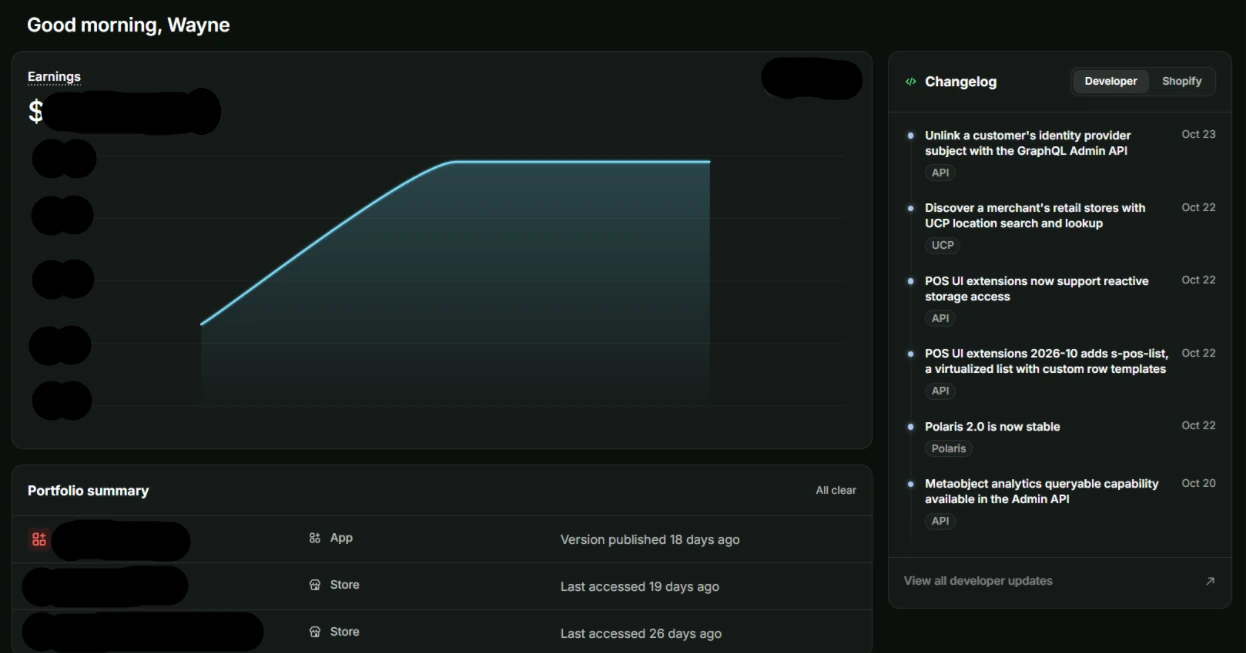
Shopify's rates and program terms in this guide were checked against Shopify's official pages on October 24, 2026. Shopify can change these terms, so confirm current rates in the Partner Dashboard and Shopify's documentation before relying on them. The example figures are illustrative, not income promises, and the featured screenshot is a real Shopify Partner Dashboard with earnings figures and app and store names hidden.
- A New Partner Earning Model Built for Shared GrowthShopify: Launch revenue share from August 10, 2026, other payouts, and Shopify's own earning examples (July 7, 2026).
- Partner earnings FAQShopify Help Center: Eligibility, eligible GMV, conditions, payout schedule and the $25 minimum.
- Partner Program glossaryShopify Help Center: The free Partner Program, client transfer stores, development stores and collaborator accounts.
- Client transfer stores and collaborationsShopify Help Center: How client transfer stores, development stores and collaborations differ.
- Revenue share for Shopify App Store developersShopify.dev: The $1 million lifetime threshold, 15% share, 2.9% processing fee and $19 registration.
- Update to Shopify's app developer revenue shareShopify.dev changelog: The move from an annual to a lifetime $1 million threshold, counted from January 1, 2025.
- Revenue share for Shopify Theme Store developersShopify.dev: The 15% revenue share on gross theme sales and the 2.9% processing fee.
- Eligibility for the Shopify Partner DirectoryShopify Help Center: Which partner tiers are invited, and the Verified Skill requirement.
- How the Partner Directory worksShopify Help Center: Merchant filters, lead forms, ranking and reviews.
Clear answers before you plan
Frequently Asked Questions
How does Shopify pay developers?
Through the Shopify Partner Program. For stores built and transferred on or after August 10, 2026, Shopify pays the launch partner 20% of the merchant's subscription fee and 0.1% of eligible online GMV for four years. Shopify also pays App Store and Theme Store developers their share of sales, twice a month once the balance reaches $25.
Does maintaining a Shopify store earn Partner revenue share?
No. The launch revenue share goes to the partner who built and transferred the store, and only one partner can earn it on a store. A developer who joins later through collaborator access earns from the maintenance agreement with the merchant, not from Shopify's revenue share.
How much does Shopify take from app sales?
Nothing on the first $1 million of lifetime gross app revenue, counted from January 1, 2025, then 15% above that. A 2.9% processing fee and sales tax apply separately. Registration costs a one-time $19, and very large developers pay 15% on all app revenue.
How much does Shopify take from theme sales?
Shopify's documentation lists a 15% revenue share on Shopify Theme Store sales, calculated on gross sales. The developer keeps 85% before the 2.9% processing fee and applicable sales tax. Submitting a theme for listing is free, but every theme must pass Shopify's review before it is sold.
Is the Shopify Partner Program free to join?
Yes. Shopify describes it as a free program for freelancers and agencies who build stores, build apps or refer clients. Members get free development stores and client transfer stores, collaborator accounts for client work, and an earnings dashboard. Directory listings and higher partner tiers come later and have their own requirements.
Can a beginner make money as a Shopify developer?
Yes, though usually through client work first. Small, well-scoped jobs such as theme fixes, new sections and store setup build experience, reviews and a portfolio. Apps, themes and launch revenue share become more realistic once a developer can deliver and support work reliably.
A practical next step
Need a Hand With a Shopify Project?
Conduit Code Labs works on Shopify development, custom functionality, apps, integrations and technical improvements for growing businesses. Share the goal, the current setup and what success should look like to plan a practical next step.

About the author
Wayne Pastoral
Full-stack developer behind Conduit Code Labs, working across Shopify, WordPress, web applications, performance, accessibility, and integrations.
Learn more about WayneContinue reading
More from Business & Commerce
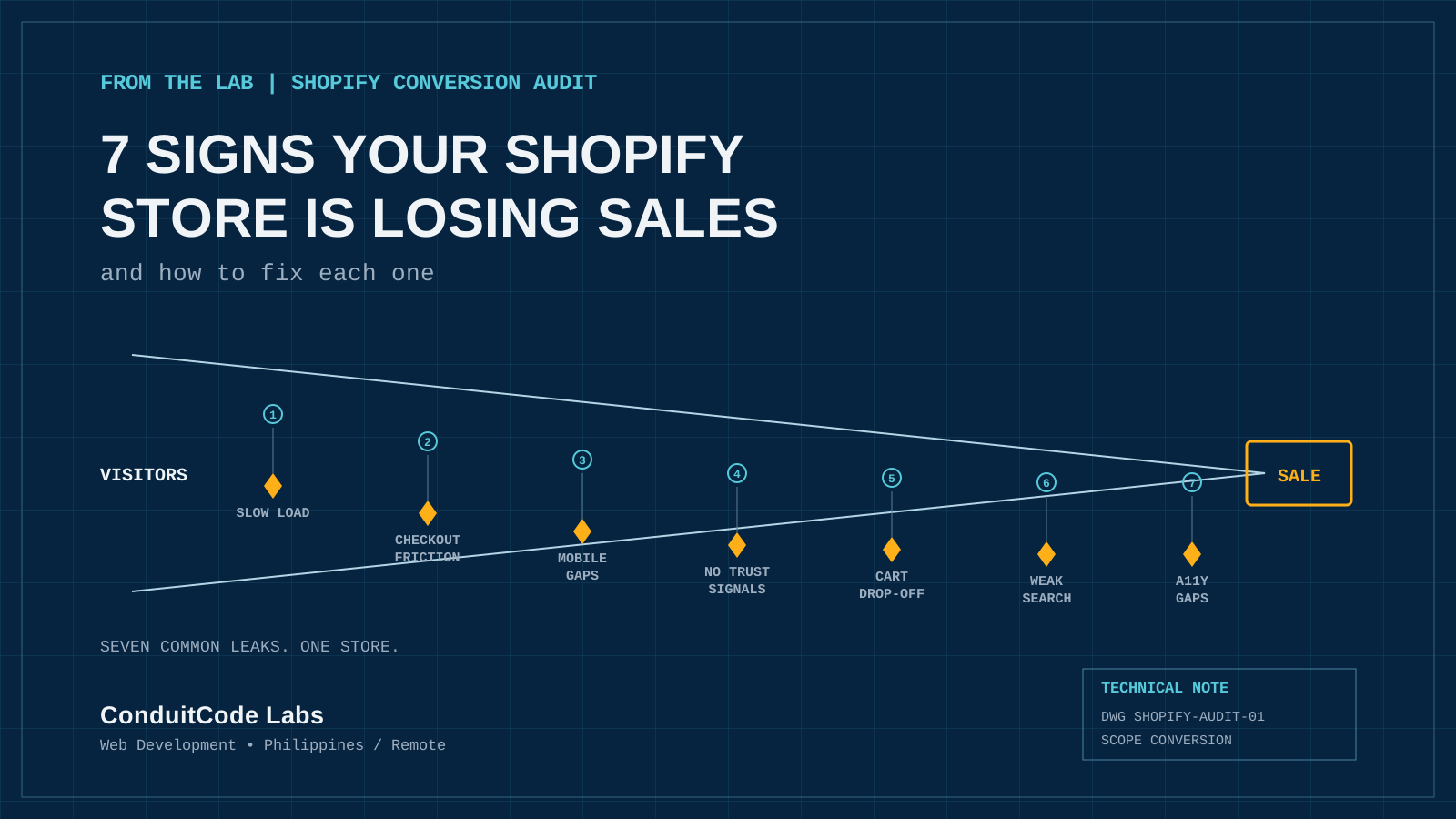
7 Signs Your Shopify Store Is Losing Sales
Traffic is not always the problem. These seven conversion leaks can quietly cost sales across product pages, checkout, mobile UX, trust, search, cart recovery, and accessibility.
Read article
Black Friday Website Checklist: What to Fix Before the Sale Starts
Prepare your online store for Black Friday 2026 with practical checks for discounts, mobile checkout, speed, stock, shipping, tracking, and launch day.
Read article
How Much Does a Website Cost in the Philippines in 2026?
Website cost in the Philippines for 2026, with realistic PHP and USD ranges for business sites, e-commerce, custom apps, hosting, and maintenance.
Read article