
The Pomodoro Technique: How to Focus Better, Study Smarter, and Get More Done
A practical, research-backed guide to the Pomodoro Technique: how the 25/5 method works, what studies say about breaks and focus, and how to adapt it for studying, coding, writing, and deep work.
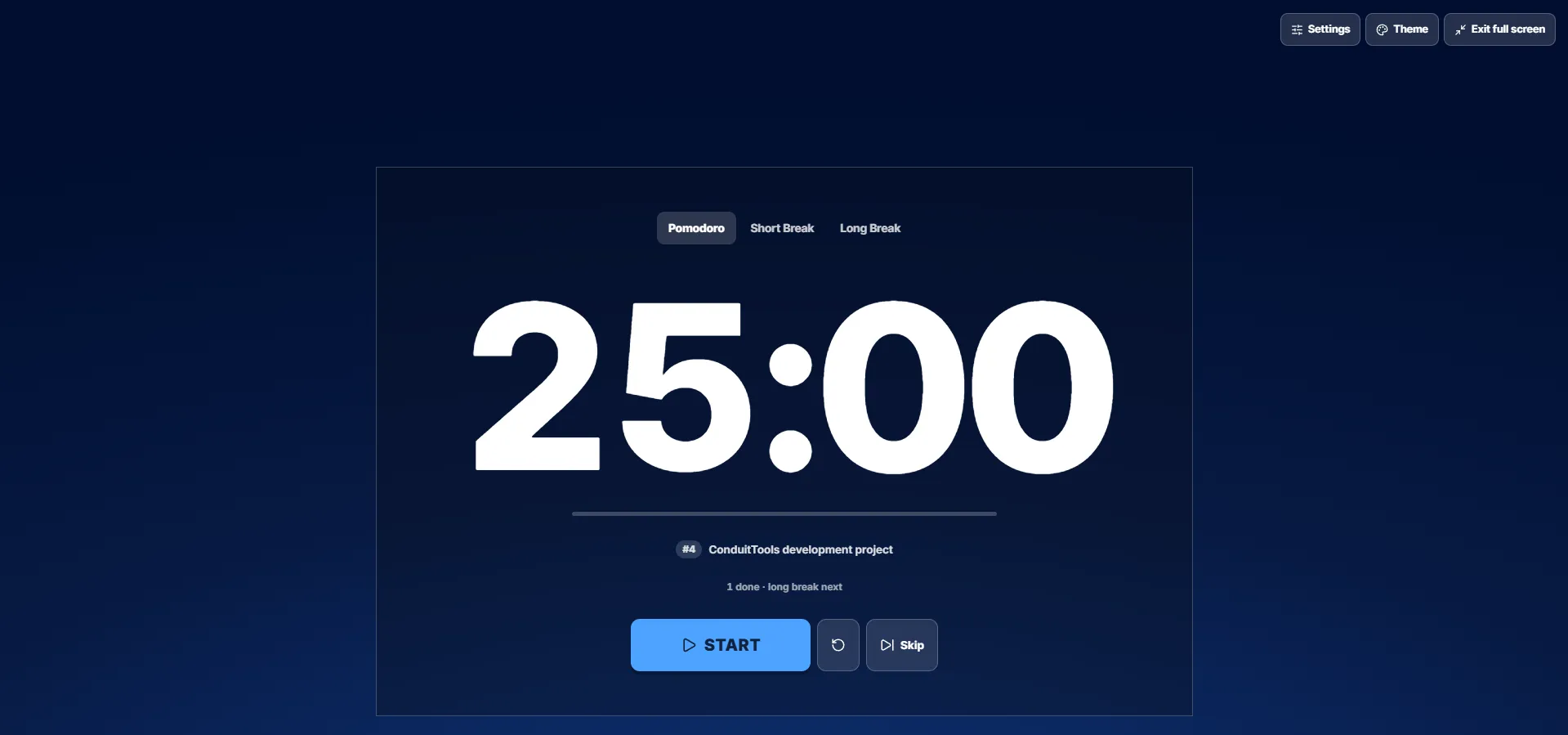
The Pomodoro Technique is simple: choose one task, work on it for a defined interval, take a short break, and repeat. The classic version uses 25 minutes of focused work followed by a 5-minute break, with a longer break after four sessions. That structure can make it easier to start, reduce task switching, and create more intentional recovery. But the evidence is more nuanced than many productivity posts suggest. Short breaks can help with fatigue and vigor, while research does not show that one fixed 25/5 schedule is universally best for learning or performance. Treat Pomodoro as a practical framework you can test and adjust, not as a scientific rule.
What Is the Pomodoro Technique?
The Pomodoro Technique is a time-management method developed by Francesco Cirillo while he was a university student. The name comes from the tomato-shaped kitchen timer he used while experimenting with short periods of focused work. Pomodoro is the Italian word for tomato.
A Pomodoro is more than a countdown. You decide what the session is for before the timer starts, protect that interval from avoidable interruptions, take a deliberate break, and keep track of completed sessions so you can plan future work more realistically.
To put the method into practice while reading, open the ConduitTools Pomodoro Timer in another tab and use it alongside this guide.
- Choose one task or a clearly defined batch of small tasks.
- Set a timer for 25 minutes.
- Work on that task without switching to unrelated work.
- When the timer ends, record the session.
- Take a 5-minute break.
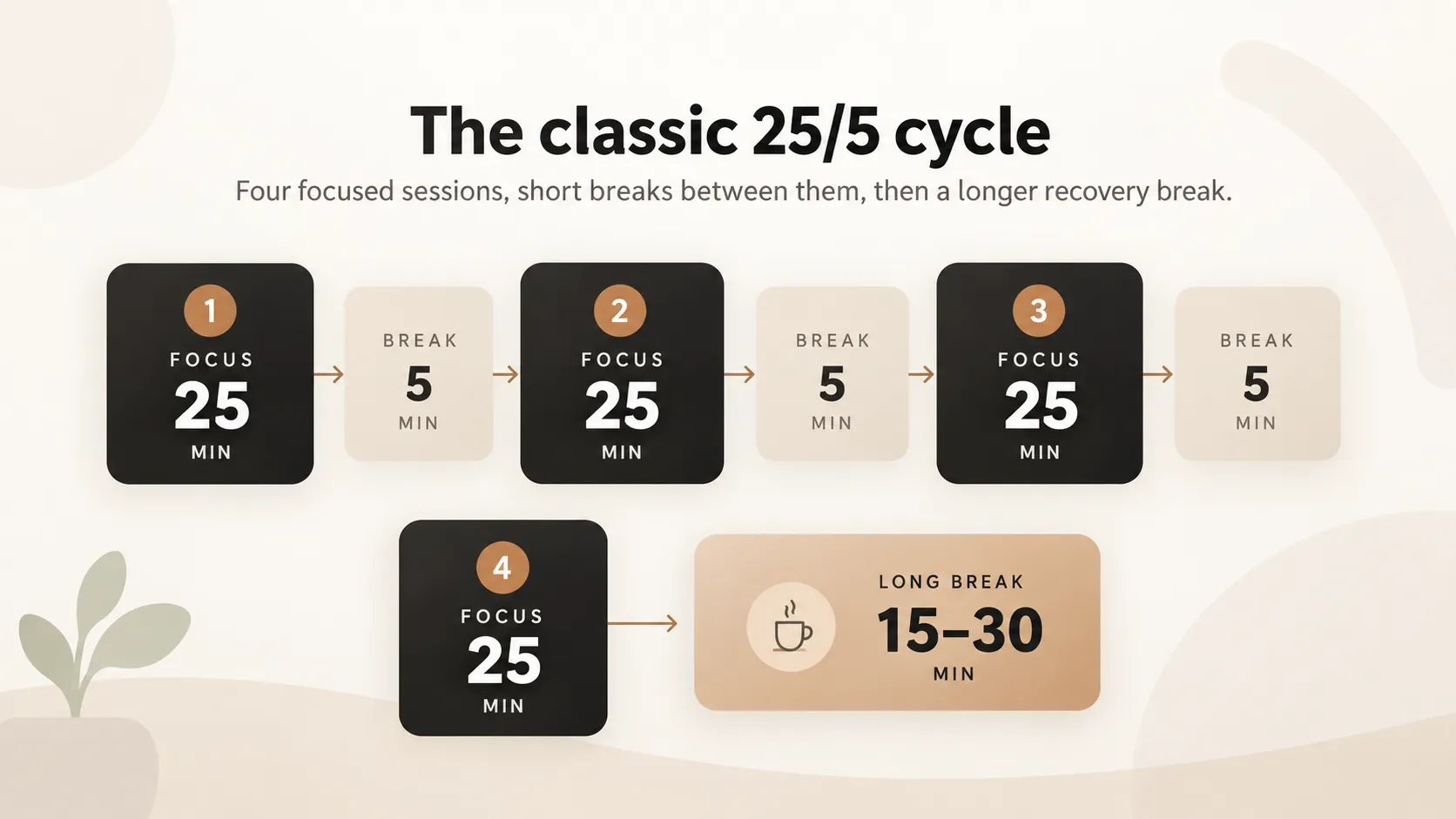
- After four Pomodoros, take a longer break of around 15 to 30 minutes.
The Classic 25/5 Cycle
The classic cycle is four focus sessions separated by short breaks, followed by a longer recovery period. The fixed rhythm removes one decision from the workday: you already know when to focus and when to step away.
The timer is not supposed to force every task into exactly 25 minutes. If a task is too large, split it into smaller outcomes. If several tiny tasks take only a few minutes each, batch them together instead of creating a separate timer for every item.
For example, a developer might use four sessions for investigating a bug, implementing the fix, testing edge cases, and reviewing the final change. A student might use them for learning a concept, answering practice questions, reviewing mistakes, and recalling the material without notes.
Why Pomodoro Can Help
Pomodoro can help because open-ended work is difficult to start. “Finish the project” can describe several hours of effort without telling you what to do first. “Work on the checkout bug for 25 minutes” is smaller, clearer, and easier to begin.
The method also makes distraction more visible. During an unstructured work block, checking one notification can quietly become ten minutes of switching between messages, tabs, and unrelated tasks. A protected interval creates a clear rule: capture the interruption if it can wait, then return to the current task.
The break matters too. It gives you permission to stop before a long session turns into low-quality screen time. For some people, that rhythm makes sustained work feel more manageable than trying to concentrate indefinitely.
The timer is useful because it creates a boundary. Focus is the goal, not the countdown.
What the Research Actually Says
The scientific case for Pomodoro is often overstated. Research supports taking breaks, but that is not the same as proving that exactly 25 minutes of work and 5 minutes of rest is optimal for everyone.
A 2022 systematic review and meta-analysis covering 22 independent samples and 2,335 participants found that micro-breaks of 10 minutes or less had small but statistically significant benefits for vigor and fatigue. The overall effect on performance was not statistically significant, although performance varied by task and tended to improve as breaks became longer.
More direct Pomodoro research is also mixed. A 2025 study of 94 university students compared Pomodoro, Flowtime, and self-regulated breaks during a two-hour study session and found no significant differences in overall productivity, task completion, or flow. A 2026 experiment with 176 students similarly found no significant learning-performance difference between systematic short breaks and self-regulated breaks, while the self-regulated group reported more positive mood-related outcomes.
The practical conclusion is not that Pomodoro fails. It is that the timer is a structure, not a universal optimum. Breaks can help, but the best interval depends on the task, the person, and how much recovery is actually needed.
How to Use Pomodoro Well
The most useful improvement is deciding what the next session is for before you press Start. A timer cannot fix an undefined task. “Work on website” is vague. “Fix tablet navigation scrolling and test three breakpoints” gives the session a finish line.
Remove avoidable interruptions before the timer begins. Silence nonessential notifications, close unrelated tabs, and keep a quick capture list for thoughts that appear during the session. Writing “reply to client” in a note is usually enough to stop your brain from trying to hold it.
Use the break as a real break from the task. Stand, stretch, refill water, walk briefly, or look away from the screen. If your work already happens on a computer, replacing the code editor with social media may change the content without giving your attention much recovery.
- Define one concrete outcome before starting.
- Protect the session from avoidable notifications and tab switching.
- Capture unrelated thoughts instead of acting on them immediately.
- Step away during breaks when possible.
- Review whether the interval helped or interrupted your concentration.
You Do Not Have to Use Exactly 25 Minutes
Twenty-five minutes is the traditional interval, not a proven magic number. Start with 25/5 because it is simple, then adjust based on what repeatedly happens.
If you struggle to begin, a 15-minute focus block can reduce the barrier to starting. If you repeatedly reach minute 25 while deeply focused, try 40 or 50 minutes with a longer break. For complex work where rebuilding context is expensive, a longer uninterrupted block may be more efficient than stopping mechanically.
Change one variable at a time. If you alter the focus length, break length, number of sessions, and break activity all at once, it becomes harder to tell what actually improved the experience.
- Classic: 25 minutes focus / 5 minutes break.
- Short start: 15 minutes focus / 5 minutes break.
- Longer focus: 40 to 50 minutes focus / about 10 minutes break.
- Deep work: use a longer block when stopping would destroy useful context.
Pomodoro for Studying
Pomodoro is popular with students because it turns a long study session into visible rounds. The University of Pittsburgh Study Lab presents it as a structured way to combine focused study periods with intentional breaks.
The timer should sit underneath a good learning strategy rather than replace one. Twenty-five minutes of passive rereading can still be less effective than twenty-five minutes of retrieval practice, solving problems, explaining a concept from memory, or reviewing mistakes.
A useful four-session study block could be: learn one concept, answer practice questions, review errors, then recall the material without notes. The timer provides the rhythm; the study method provides the learning.
Pomodoro for Developers
Development work can fit Pomodoro well when the task is scoped. Debugging one issue, writing tests, reviewing a pull request, documenting an API, refactoring one component, or researching one implementation decision can all benefit from a protected focus block.
The limitation is context. Complex programming often requires building a mental model of several files, states, data flows, and failure conditions. If the alarm repeatedly arrives just as that model becomes useful, stopping at minute 25 may create more overhead than benefit.
For technical work, use the timer as a guardrail rather than an authority. It can help you start and prevent hours of unbroken screen time, but longer intervals are reasonable when the work genuinely benefits from sustained context.
When Fixed Pomodoros Do Not Fit
Pomodoro is not ideal for every situation. Interruption-heavy roles, live support, meetings, collaborative sessions, or tasks that naturally vary in length may not fit rigid 25-minute blocks.
Flowtime is a useful alternative when preserving flow matters more than fixed timing. You start working, record how long you remain focused, and take a break based on the session rather than an alarm. Time blocking solves a different problem: it reserves a period on your calendar for a type of work. You can combine the two by blocking two hours for a project and then using Pomodoro or Flowtime inside that window.
If the timer helps you begin but often interrupts productive concentration, keep the structure and lengthen the interval. If timers themselves make the work more stressful, use a more flexible method instead.
Common Pomodoro Mistakes
Most problems with Pomodoro come from using the timer mechanically while ignoring the work around it. A countdown cannot compensate for vague priorities, constant notifications, unrealistic planning, or breaks that are not actually restorative.
- Starting the timer before deciding what the session is for.
- Treating every message or notification as an immediate interruption.
- Using every break to continue working.
- Opening a feed during a 5-minute break and returning twenty minutes later.
- Forcing 25-minute intervals even when they repeatedly interrupt useful flow.
- Counting Pomodoros as a productivity score instead of checking whether meaningful work was completed.
- Assuming the method is scientifically proven to maximize performance for everyone.
Test the Method Instead of Obeying It
Treat Pomodoro like a small personal experiment. Use the same setup for several comparable sessions and watch what happens.
Did you start more easily? How often did you switch tasks? Did the timer usually feel too early or too late? Were the breaks restorative? Did you complete the outcome you planned? Those signals are more useful than trying to reach a certain number of Pomodoros every day.
A good timer should support that experiment without adding friction. Useful features include adjustable focus and break durations, a session counter, long-break settings, pause and reset controls, optional auto-start behavior, sound, browser notifications, and persistence across refreshes.
The ConduitTools Pomodoro Timer gives you a practical way to run the method alongside this guide. Use it to test different focus and break lengths and keep the timer close while you work.
Plan, focus, recover, review, adjust.
The Practical Takeaway
Pomodoro works best as a simple boundary around attention. Choose one task, focus for a defined period, recover, and repeat. The research supports the value of breaks more clearly than it supports any single ideal schedule.
Start with 25/5 because it is easy to understand. Keep it if it helps. Change it if the timer repeatedly interrupts useful concentration or the break does not restore you. The goal is not to obey the timer perfectly. The goal is to create a repeatable way to start focused work and recover before the next round.
Verified references
Sources & Methodology
This guide separates the established Pomodoro method from broader research on work breaks. Evidence on micro-breaks supports modest benefits for fatigue and vigor, but that literature is not proof that a 25/5 schedule is optimal. Direct Pomodoro studies also show that flexible or self-regulated breaks can perform similarly or better on some subjective outcomes.
- The Pomodoro TechniqueFrancesco Cirillo / Pomodoro Technique: Official source for the method's creator, history, and core framework.
- Pomodoro TechniqueUniversity of Pittsburgh Study Lab: University study-skills guidance on focused study sessions and breaks.
- Give Me a Break! A Systematic Review and Meta-Analysis on the Efficacy of Micro-Breaks for Increasing Well-Being and PerformancePLOS ONE: Meta-analysis of 22 independent samples with 2,335 participants.
- Investigating the Effectiveness of Self-Regulated, Pomodoro, and Flowtime Break-Taking Techniques Among StudentsBehavioral Sciences: 2025 study of 94 university students comparing Pomodoro, Flowtime, and self-regulated breaks.
- When to Take a Break: Comparing Effects of Systematic Short (Pomodoro) and Self-Regulated Breaks on Subjective Experience and Actual LearningBehavioral Sciences: 2026 experiment with 176 university students comparing systematic and self-regulated breaks.
Clear answers before you plan
Frequently Asked Questions
What is the Pomodoro Technique?
It is a time-management method that alternates focused work sessions with planned breaks. The traditional pattern is 25 minutes of focused work, a 5-minute break, and a longer break after four Pomodoros.
Does a Pomodoro have to be 25 minutes?
No. Twenty-five minutes is the traditional interval, but there is no strong evidence that it is universally optimal. Adjust the focus and break length to the task and how your attention responds.
Is the Pomodoro Technique scientifically proven?
Research supports short breaks for outcomes such as fatigue and vigor, but it does not show that the classic 25/5 schedule is universally superior for performance or learning.
Is Pomodoro good for studying?
It can be a useful study structure because it creates bounded focus periods and deliberate breaks. The learning strategy still matters more than the timer itself.
Is Pomodoro good for coding?
Yes for scoped tasks such as debugging, tests, documentation, code review, and repetitive implementation. Longer intervals may work better for complex programming where rebuilding context is expensive.
What should I do during a Pomodoro break?
Use the break for recovery: stand, stretch, walk briefly, drink water, or rest your eyes. If your work is screen-heavy, a short non-screen break is often more restorative.
A practical next step
Try the method, then adjust the method.
Use the ConduitTools Pomodoro Timer alongside this guide to start a focus session, take a deliberate break, and test a rhythm that fits your work. The practical next step stays inside the Conduit Code Labs and ConduitTools ecosystem.

About the author
Wayne Pastoral
Full-stack developer behind Conduit Code Labs, working across Shopify, WordPress, web applications, performance, accessibility, and integrations.
Learn more about WayneContinue reading
More from Work & Technology

Why the Right Tools Matter at Work: AI, Automation, and the Small Utilities That Save Time
The right tools reduce repetitive work, shorten feedback loops, and create more room for judgment. Here is how AI, automation, and focused utilities can improve everyday work without turning the workflow into another problem.
Read article
Working From Home: What You Gain, What You Trade, and What Actually Works
Working from home can save time, improve flexibility, and create better conditions for focused work, but it can also blur boundaries and increase isolation. Here is what the research says and what makes remote work sustainable.
Read article