
Use AI. Keep Your Judgment.
AI can accelerate implementation, but understanding and ownership still decide whether the result is good.
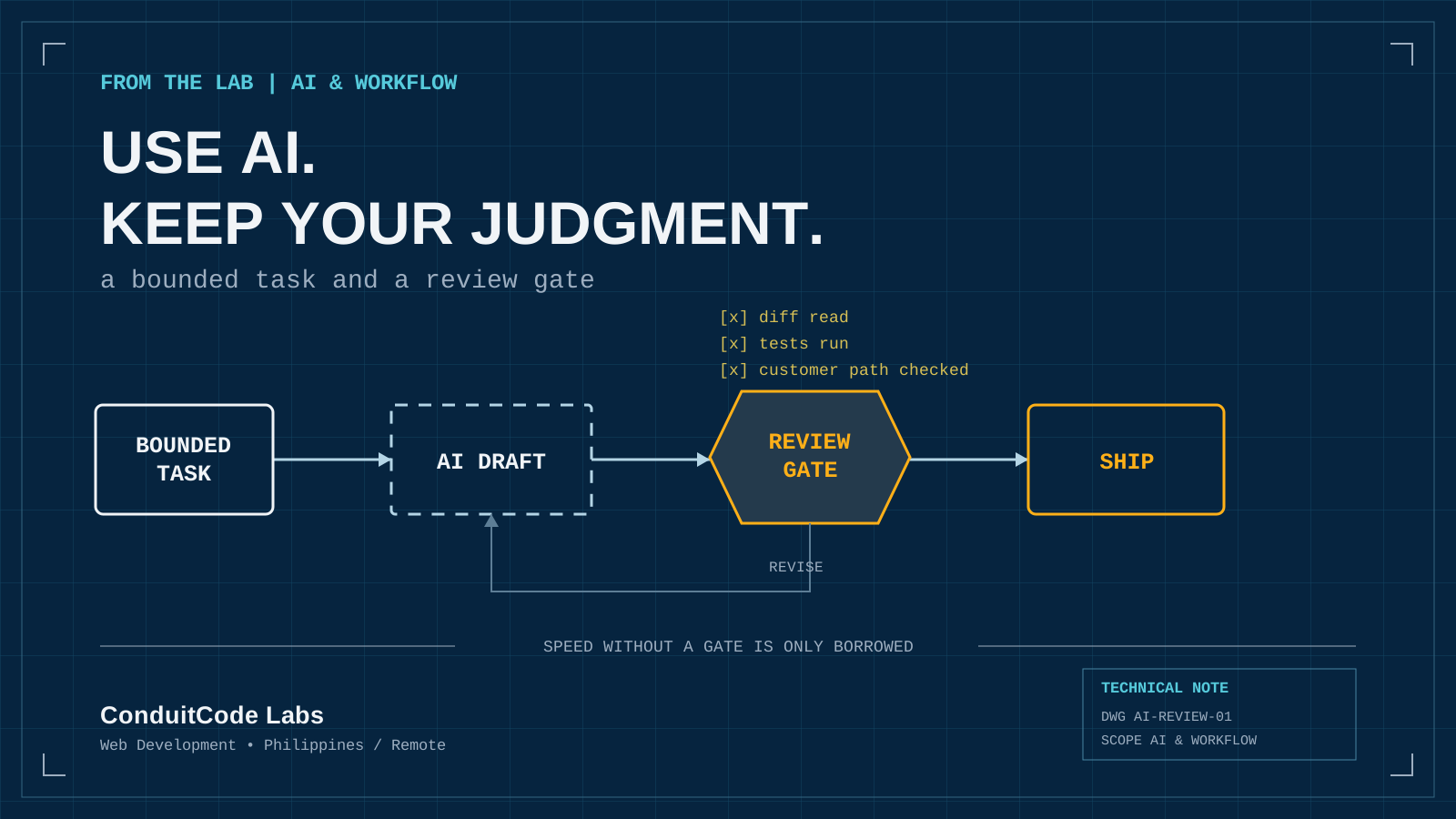
AI is useful for reducing mechanical work, exploring an unfamiliar API, and producing a first pass. The quality of the shipped result still depends on the person who defines the problem and reviews the behavior.
Give it bounded work
The best tasks have a clear surface area: translate this data shape, draft tests for these states, explain this dependency, or propose a few implementations under these constraints.
A bounded request makes the output easier to verify. Open-ended requests tend to produce confident structure without enough connection to the existing system.
Use AI to shorten the distance to a considered decision, not to remove the decision.
Keep decisions visible
Generated code should still carry the reasoning a teammate needs: why the boundary exists, which failure is handled, and what must remain true when the feature changes.
If the implementation cannot be explained without referring back to the prompt, it is not ready to own.
Review the customer-facing path
Read the diff, run the relevant tests, and use the feature from the customer's point of view. Check loading, errors, keyboard behavior, small screens, analytics, and the release path, not only the happy-path component.
Speed is valuable. Shipping a system nobody understands is only borrowed speed.
Where this saves the most time
The biggest win is not the first draft; it is the second and third. AI is fastest at work that was already mechanical: renaming, translating, scaffolding, and writing obvious test cases. The judgment calls still belong to the person who understands the system.
Verified references
Sources & Methodology
This is practical engineering guidance supported by current AI risk-management and code-review standards. It does not claim that one workflow fits every team.
- Artificial Intelligence Risk Management Framework: Generative Artificial Intelligence ProfileNational Institute of Standards and Technology: Official guidance for identifying and managing generative-AI risks.
- What to Look for in a Code ReviewGoogle Engineering Practices: Public engineering guidance for reviewing design, functionality, complexity, and tests.
A practical next step
Have a project that needs to work better?
Share the goal, the current problem, and what success should look like. Conduit Code Labs can help define a practical next step.

About the author
Wayne Pastoral
Full-stack developer behind Conduit Code Labs, working across Shopify, WordPress, web applications, performance, accessibility, and integrations.
Learn more about WayneContinue reading
More from AI & Development

AI Fatigue Is a Signal, Not a Flaw
The tiredness is not about typing less. It is about reviewing more, and reviewing never fully turns off.
Read article
GPT-6 Astra Is Here: What Developers Should Know in 2026
GPT-6 Astra brings stronger coding, computer use, research, long-context reasoning, and agentic workflows. Here is what changed, what matters for developers, and how to evaluate it without chasing launch-day hype.
Read article
How to Keep Up With Technology in the AI Era Without Chasing Every Trend
Technology is moving faster in the AI era, but keeping up does not mean learning every tool. The durable advantage is stronger fundamentals, faster learning, better judgment, and knowing what is worth adopting.
Read article